
Coin Identification Worksheet
Help children learn to recognise and count US coins. These worksheets show pennies, nickels, dimes, quarters, half dollars and dollar coins at actual size, with who appears on each, what it is worth and clues such as colour, size and edge — then move on to matching, sorting and counting money with answer keys.
- Instant download
- Editable Word
- Print-ready PDF
- 7-day refund
6 files · PDF, DOCX
US Coin Identification Worksheets
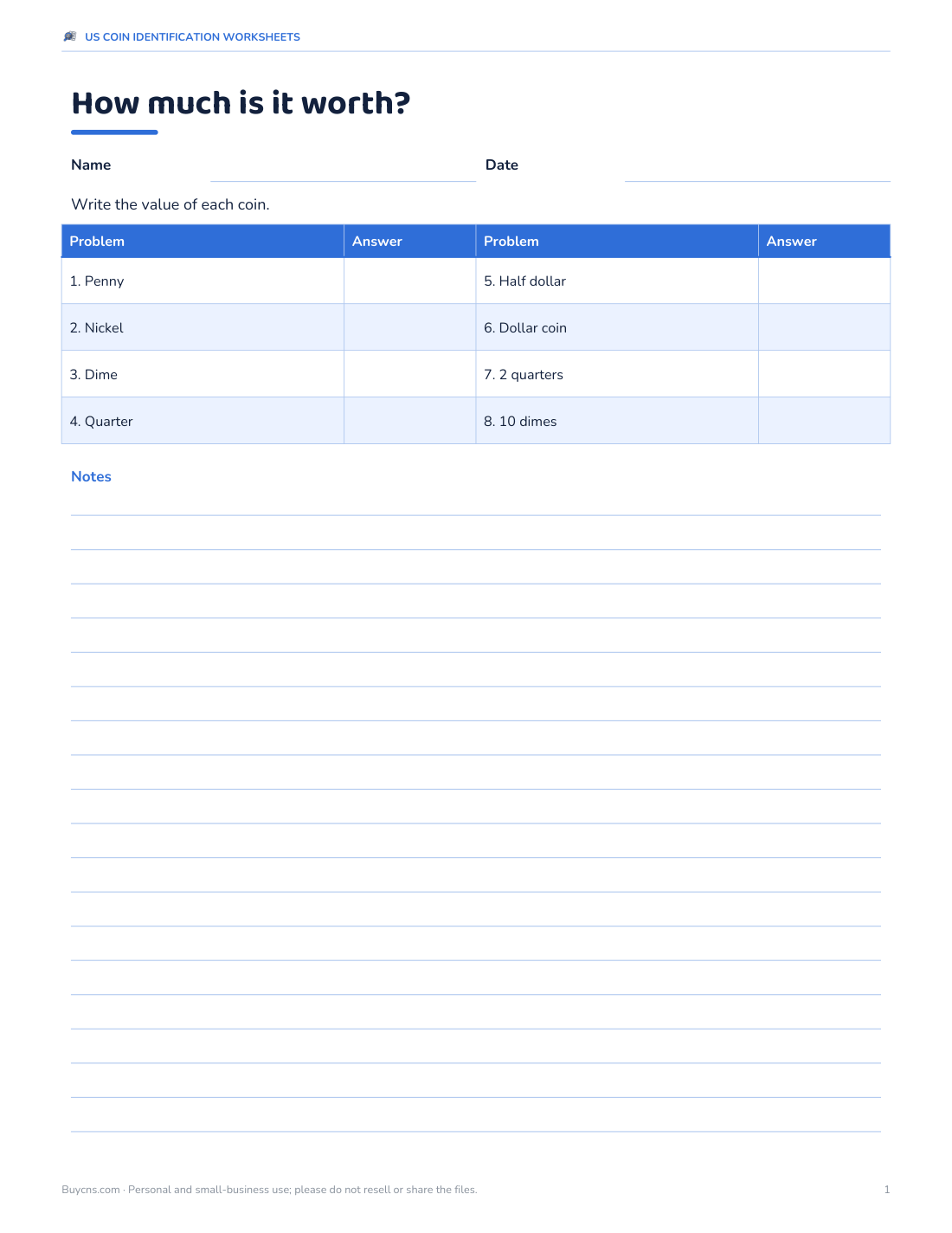
Actual-size US coin chart, identify-the-coin and value matching worksheets, coin clue cards, counting money practice and a coin rubbing sheet, with answer keys.
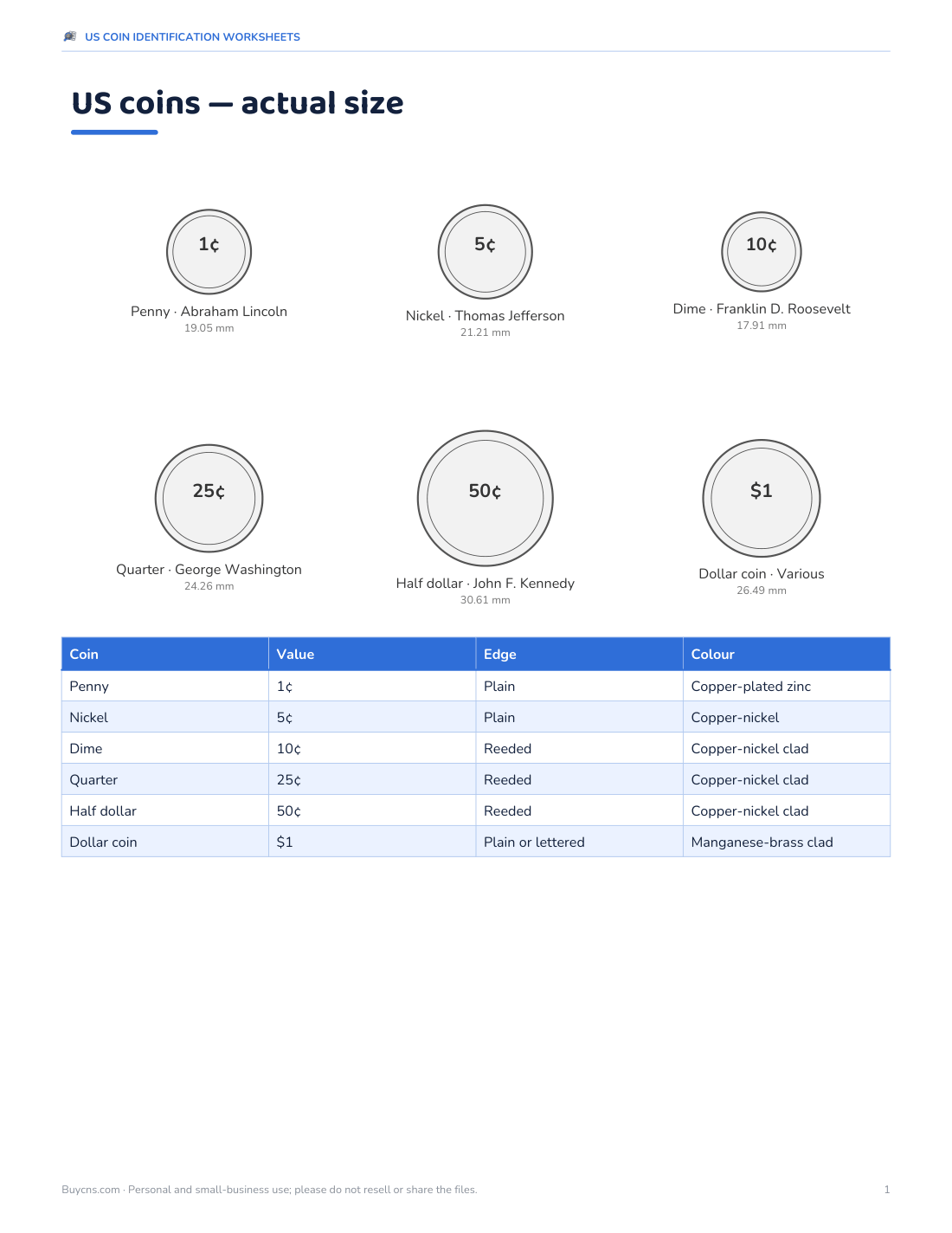
- Actual-size coin chart (PDF)
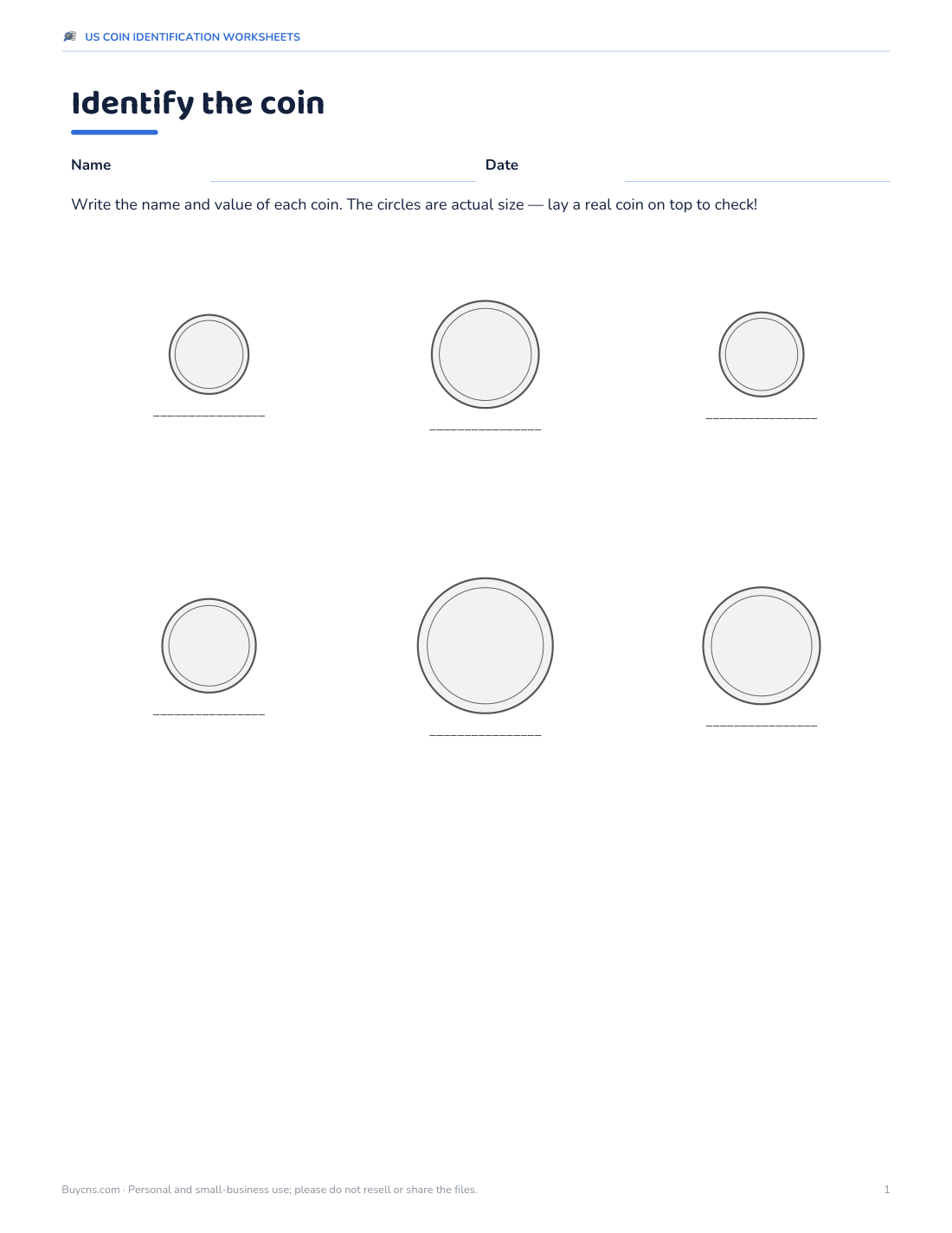
- Identify the coin (PDF)
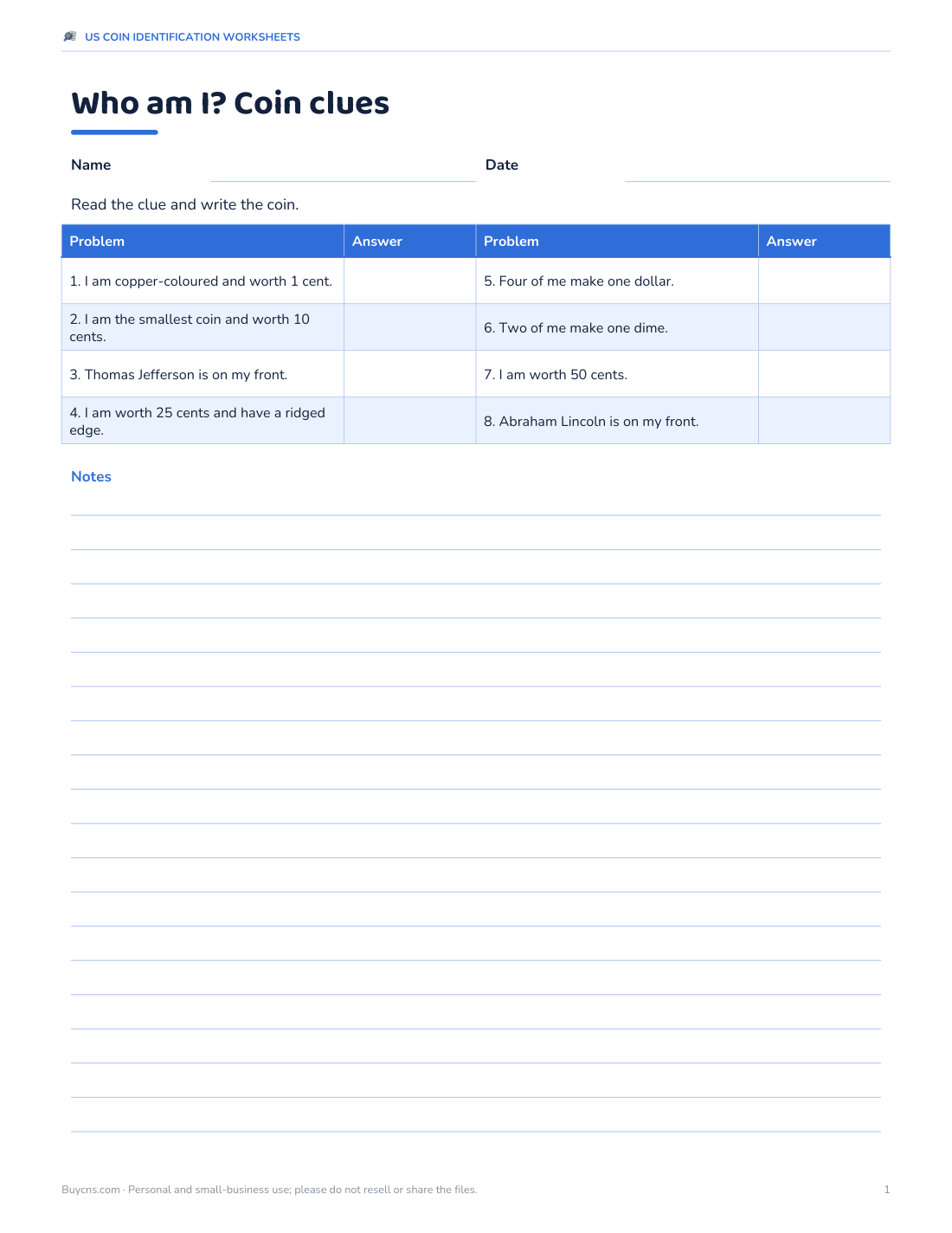
- Coin clues (PDF, DOCX)
- + 3 more
$5.00 USD, one-time 6 files · about $0.83 each
- Instant download
- 7-day refund
- Secure checkout by Stripe
7-day money-back guarantee. Full refund within 7 days of purchase, even after you download.
Free sample: Actual Size Coin Chart (PDF, 62 KB)
US Coin Identification Worksheets
Actual-size US coin chart, identify-the-coin and value matching worksheets, coin clue cards, counting money practice and a coin rubbing sheet, with answer keys.
- Actual-size coin chart (PDF)
- Identify the coin (PDF)
- Coin clues (PDF, DOCX)
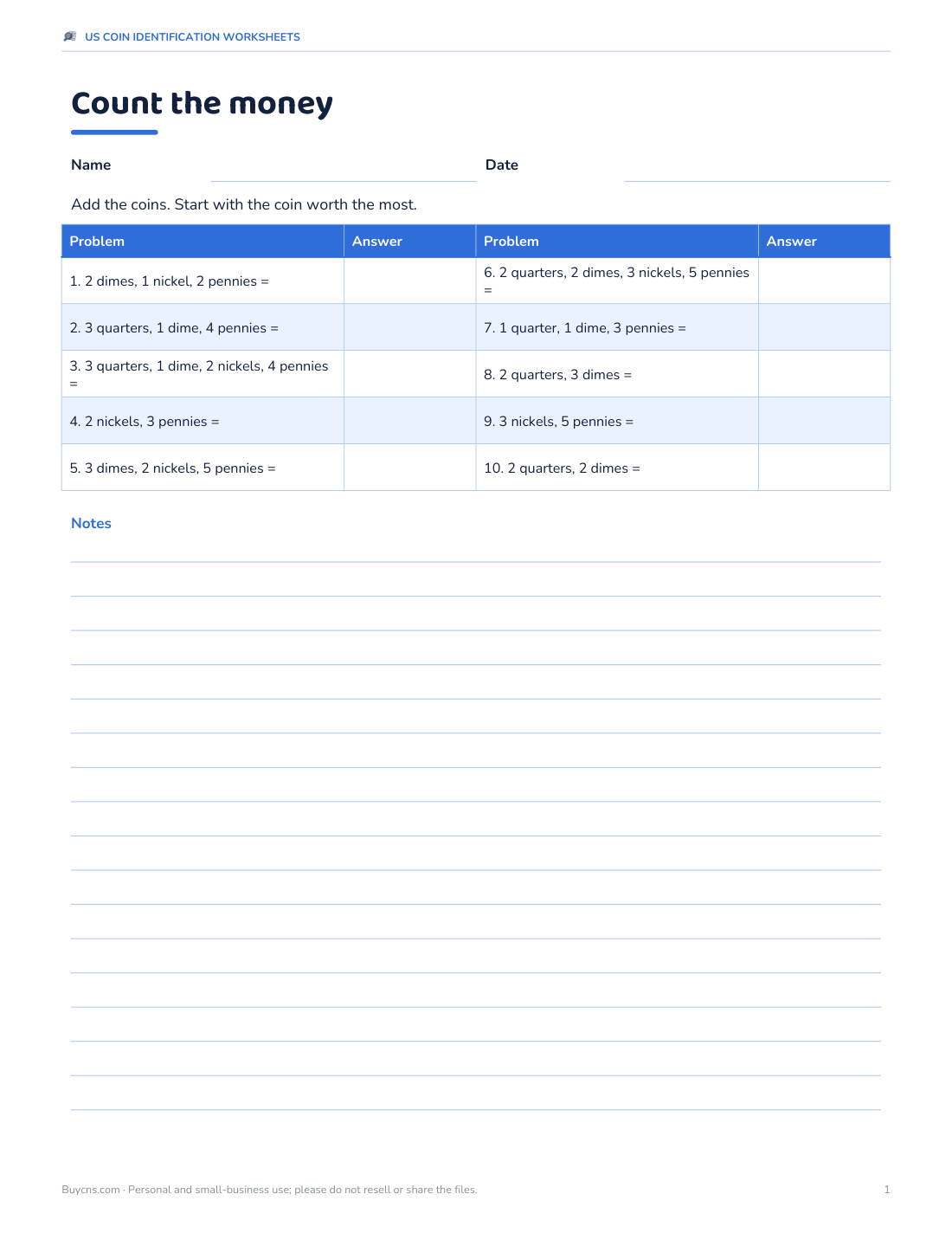
- Counting coins (PDF, DOCX)
- Match value to coin (PDF, DOCX)
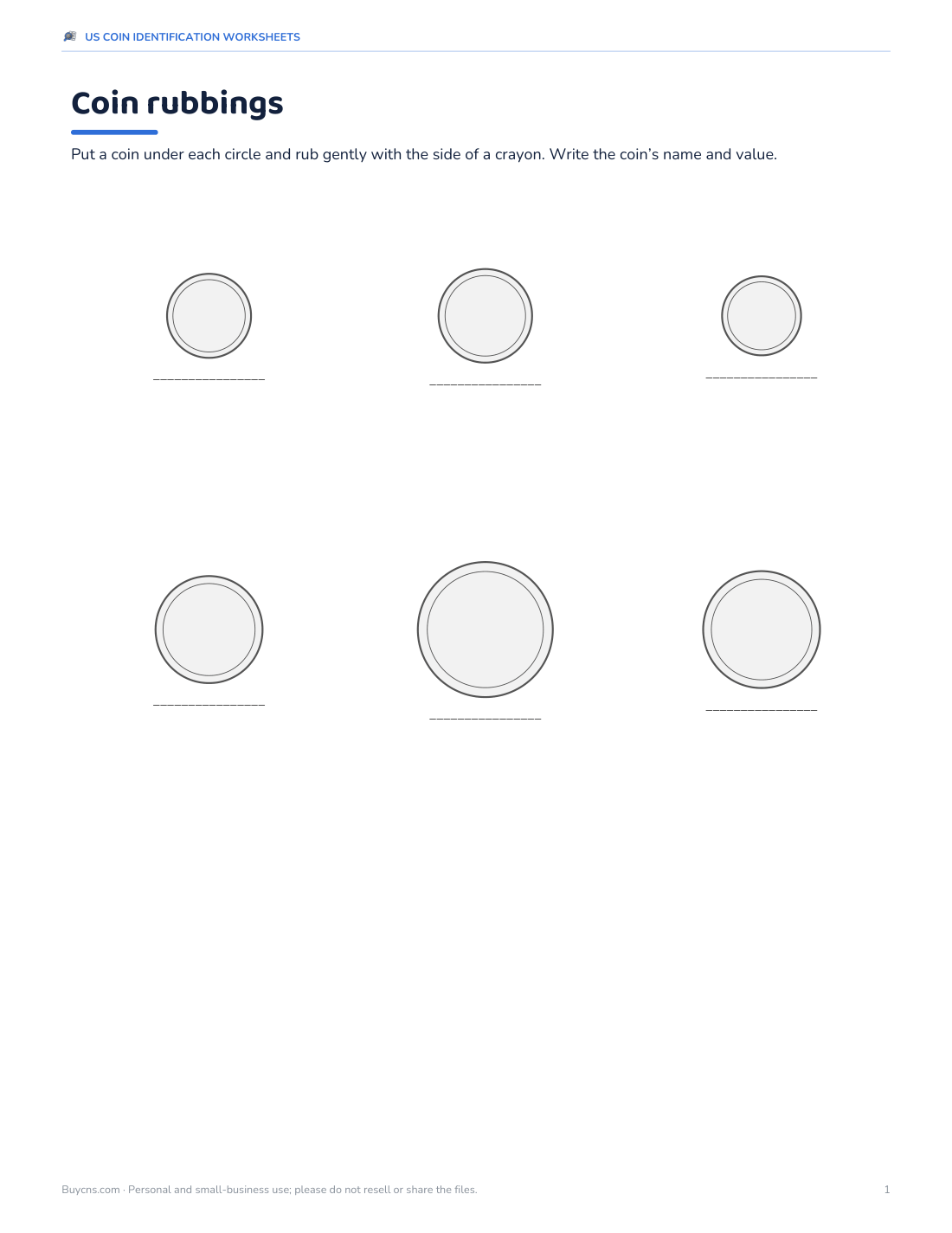
- Coin rubbing sheet (PDF)
Formats: PDF, DOCX. Instant download after payment (link valid 72 hours, up to 5 downloads). AI-assisted: the templates were drafted with AI help and reviewed and laid out before publishing.
$5.00 USD, one-time 6 files · about $0.83 each
- Instant download
- 7-day refund
- Secure checkout by Stripe
7-day money-back guarantee. Full refund within 7 days of purchase, even after you download.
Free sample: Actual Size Coin Chart (PDF, 62 KB)
Full refund within 7 days — see the refund policy and license.
Free printables
Single sheets you can print right now, no sign-up. The full pack adds every sheet in one download plus the editable files.
 Printable Coin Identification Chart1 page · free PDF
 Printable Coin Identification Worksheet2 pages · free PDF
 Printable Coin Clues Worksheet2 pages · free PDF
 Printable Coin Counting Worksheet2 pages · free PDF
 Printable Coin Value Match Worksheet2 pages · free PDF
 Printable Coin Rubbing Sheet1 page · free PDF
US coin facts
| Coin | Value | Front (obverse) | Diameter | Edge | Colour / metal |
|---|---|---|---|---|---|
| Penny | 1¢ | Abraham Lincoln | 19.05 mm | Plain | Copper-plated zinc |
| Nickel | 5¢ | Thomas Jefferson | 21.21 mm | Plain | Copper-nickel |
| Dime | 10¢ | Franklin D. Roosevelt | 17.91 mm | Reeded | Copper-nickel clad |
| Quarter | 25¢ | George Washington | 24.26 mm | Reeded | Copper-nickel clad |
| Half dollar | 50¢ | John F. Kennedy | 30.61 mm | Reeded | Copper-nickel clad |
| Dollar coin | $1 | Various (e.g. Sacagawea) | 26.49 mm | Plain or lettered | Manganese-brass clad |
Coin specifications are from the United States Mint. Designs on the back (reverse) of the penny, nickel, quarter and dollar coin have changed over the years, so the fronts are the most reliable feature for young learners.
How children tell coins apart
- Colour — the penny is the only copper-coloured coin; the others are silver-coloured (and the dollar coin is golden).
- Size — the dime is the smallest coin even though it is worth more than a penny or nickel, which confuses many children.
- Edge — dimes and quarters have ridged (reeded) edges; pennies and nickels are smooth.
- Face — Lincoln on the penny, Jefferson on the nickel, Roosevelt on the dime, Washington on the quarter.
- Words — each coin names its value: ONE CENT, FIVE CENTS, ONE DIME, QUARTER DOLLAR.
What is in the worksheet pack
- Actual-size coin chart — outlines of each coin at real diameter, with value and front portrait.
- Identify the coin — write the name and value under each actual-size outline.
- Match value to coin — connect 1¢, 5¢, 10¢, 25¢, 50¢ and $1 to the coin names.
- Clue cards — “I am the smallest coin. I am worth 10 cents. Who am I?”
- Counting coins — add mixed quarters, dimes, nickels and pennies, with answer key.
- Coin rubbing sheet — place real coins under the paper and rub with a crayon.
Teaching sequence
- Name and sort real coins by colour and size.
- Learn the value of each coin.
- Count groups of the same coin: skip count by 5s, 10s and 25s.
- Count mixed coins, starting with the largest value.
- Make a given amount in different ways.
- Compare amounts and make change.
Hands-on practice with real coins before worksheets helps children connect the pictures to the money they see every day.
Tips for counting money
- Sort coins from greatest to least value before counting.
- Count quarters by 25s, dimes by 10s, nickels by 5s, then pennies by 1s.
- Practise with a pretend shop with price tags up to $1.
- Remember that 100 cents equals one dollar.
- Use the cent sign (¢) for amounts under a dollar and the dollar sign with a decimal point ($1.25) for larger amounts.
Who it is for
Kindergarten to grade 3 teachers, homeschooling families, tutors, and parents helping children with money skills. Common US standards introduce coin identification in kindergarten and first grade and counting money in second grade.
Formats
Worksheets are print-ready PDFs on US Letter. Print at 100% (“Actual size”) so the coin outlines match real coins — children can check by laying a coin on the circle. Answer keys are included.
Checking coins with the actual-size chart
Because the outlines are printed at the real diameters published by the US Mint, children can place real coins on the circles to check their answers — a satisfying, self-correcting activity. Make sure the print dialog is set to 100% or “Actual size”; “Fit to page” shrinks everything slightly. A ruler across the dime circle should measure just under 18 mm.
Games with coins
Coin games keep practice fun: roll dice and collect that many pennies, trading five pennies for a nickel and so on (“race to a dollar”); play shop with price tags; or hide coins in a feely bag and identify them by touch using size and edge. Each game reinforces value, size and counting in a different way.
Frequently asked questions
Are the coins shown at actual size?
Yes, when printed at 100% scale the outlines match US Mint diameters.
Which coin is the smallest?
The dime, at 17.91 mm.
Who is on the nickel?
Thomas Jefferson.
What grades are these worksheets for?
Kindergarten to grade 3.
Was AI used to create the worksheets?
The worksheets were generated by script from US Mint specifications with text drafted with AI assistance, then checked before publishing.